
2026 · Web + iOS · Firebase
Pracchess.
Openings aren't learned by reading them.
They're learned by playing them back, one move at a time.
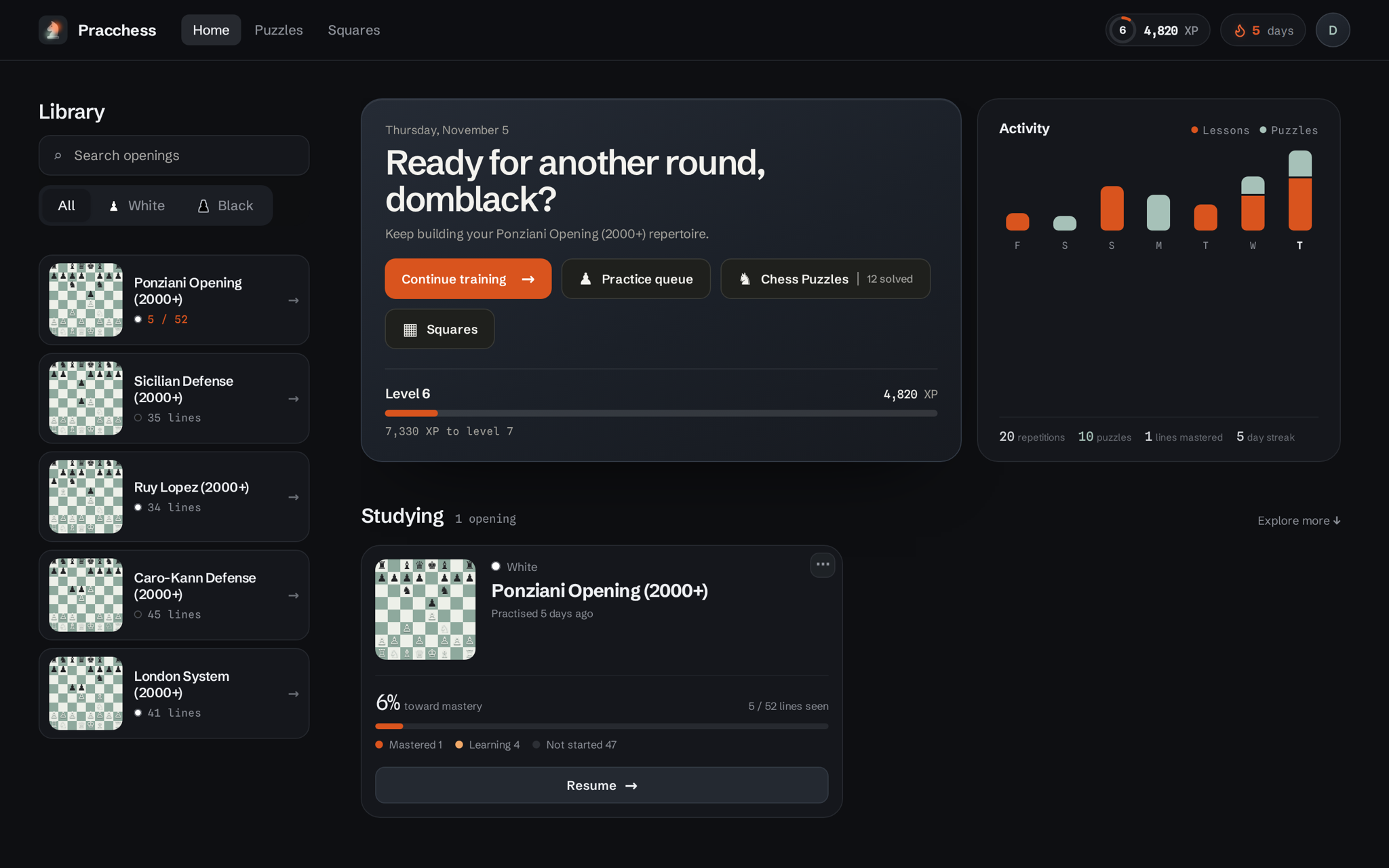
Five repertoires. 207 engine-checked lines. Hints when you need them, automatic replies when you don't, and a progress system that remembers every repetition.
The idea
Chess apps are built to entertain.
This one is built to remember.
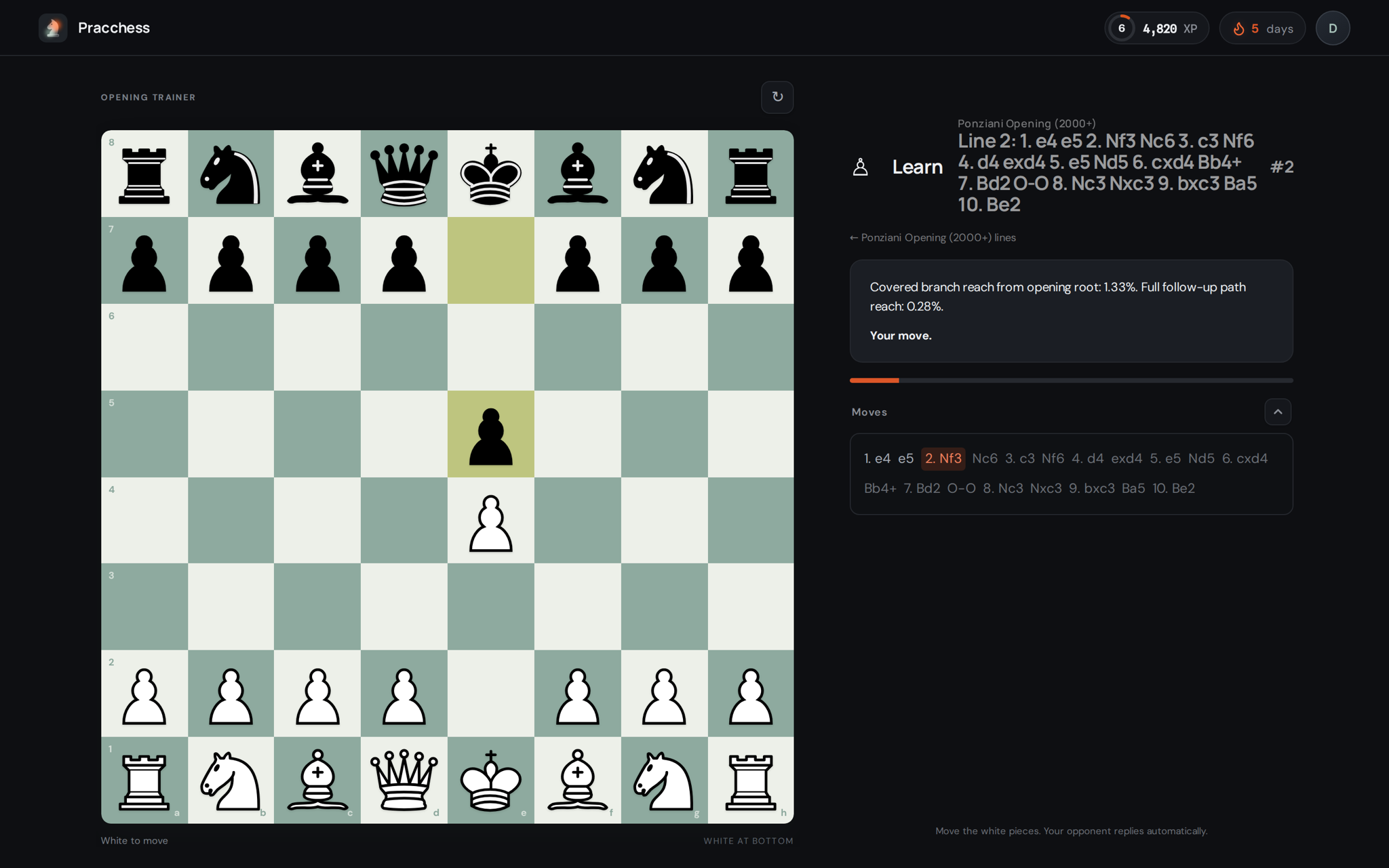
Pracchess is a practice tool, not a playing site. You choose a repertoire, the board puts you in the position, and the opponent answers instantly. Repeat a line five times and it is mastered. The interface stays out of the way until you ask for a hint.
5
curated openings
207
repertoire lines
64
squares drilled
0
web runtime deps
The board
Not a video. A chess board that actually plays chess.
Every move is checked against the real rules. The board tracks checks and pins, keeps castling rights, handles en passant, asks you to pick a promotion piece, and recognises mate, stalemate, insufficient material, and the fifty-move rule.
- Legal move generation with check and pin detection
- Castling rights, en passant, and promotion
- Checkmate, stalemate, insufficient material, fifty-move rule
- Standard algebraic notation, click or drag, undo, and board flip
Tactics
When the repertoire runs out, the puzzles take over.
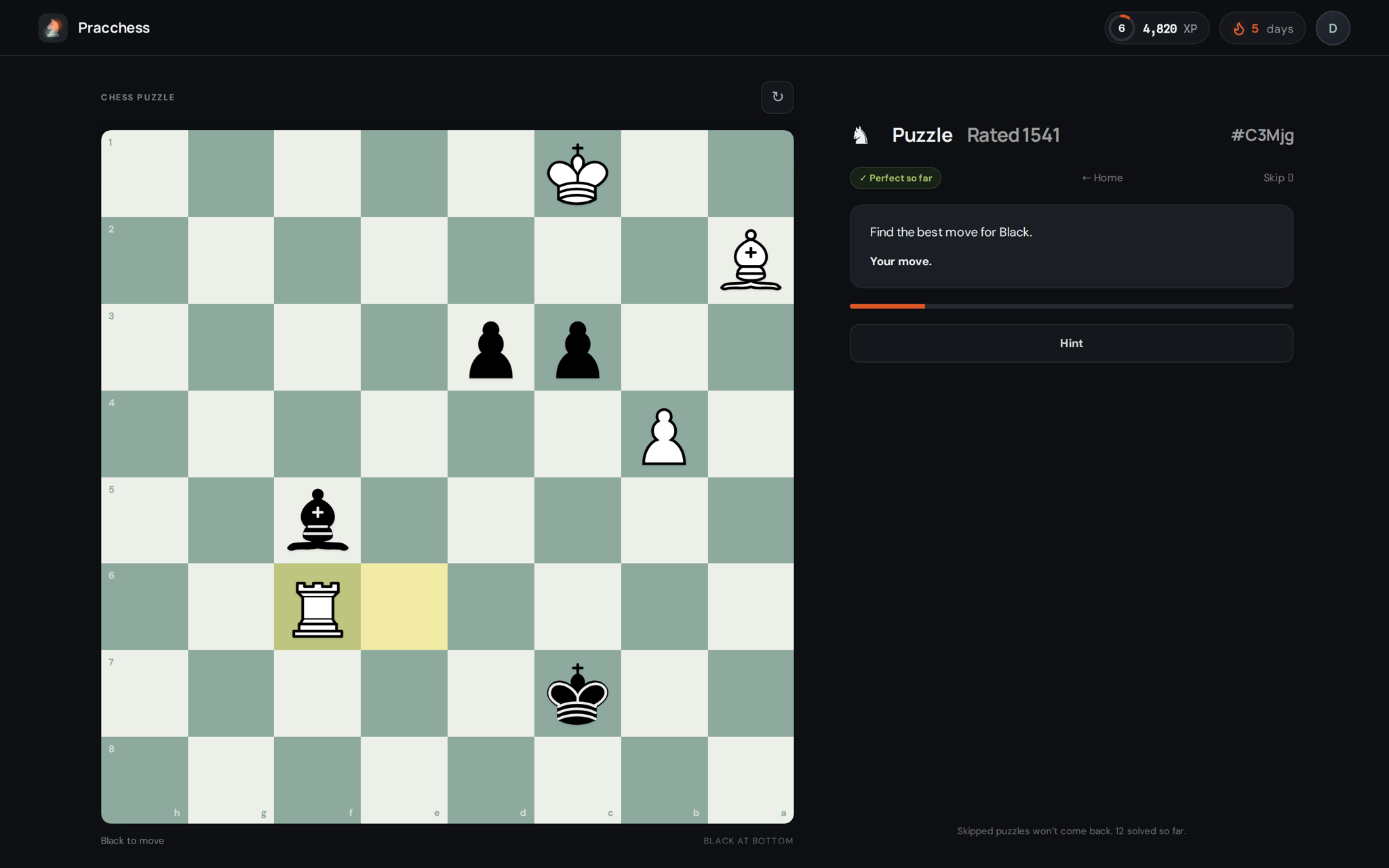
Pracchess serves CC0 Lichess puzzles one at a time, in a random order per user. A puzzle is recorded the moment it is served, so it can never come back. Hints are available, skips are tracked, and every solve pays XP. The queue is prefetched ahead of play so the next board is ready before you are.
The repertoire
Lines chosen by humans. Checked by an engine. Documented like a lab result.
The lesson pipeline is a Python toolchain built around Lichess and Stockfish. It is not a scraper with a prompt bolted on. It decides what belongs in a repertoire, then records exactly why.
Human data
Start with what people actually play.
Lichess Opening Explorer supplies the candidate moves, split by rating bucket and time control. Popularity decides what is worth training.
Engine filter
Keep only moves worth memorising.
Stockfish evaluates the position at depth 22 or better. Moves below the evaluation floor are pruned, and common opponent mistakes become their own branches.
Audit trail
Every line explains itself.
Each generated lesson ships with a report: leaf probability, stopping reason, omitted and pruned probability, engine identity, and cache statistics.
The account
Progress you can't fake.
A trainer is only useful if the numbers mean something. Pracchess keeps every practice record in Firestore, but only the backend can write the totals.
20
repetitions
10
puzzles
5
day streak
Email, password, or Google.
Firebase Auth handles sign-in, password resets, and verification. Email enumeration protection is enabled and the password policy is enforced server-side.
One document per line.
Practice records live under users/{uid}/progress/{lessonId}:{lineId}, so a large repertoire never hits a document-size ceiling or rewrites a giant map.
The server keeps score.
Cloud Functions write repetitions, streaks, mastery, and XP through the Admin SDK. Security rules make those fields read-only for clients, so progress cannot be forged.
Board vision
Sixty-four squares. One running clock.
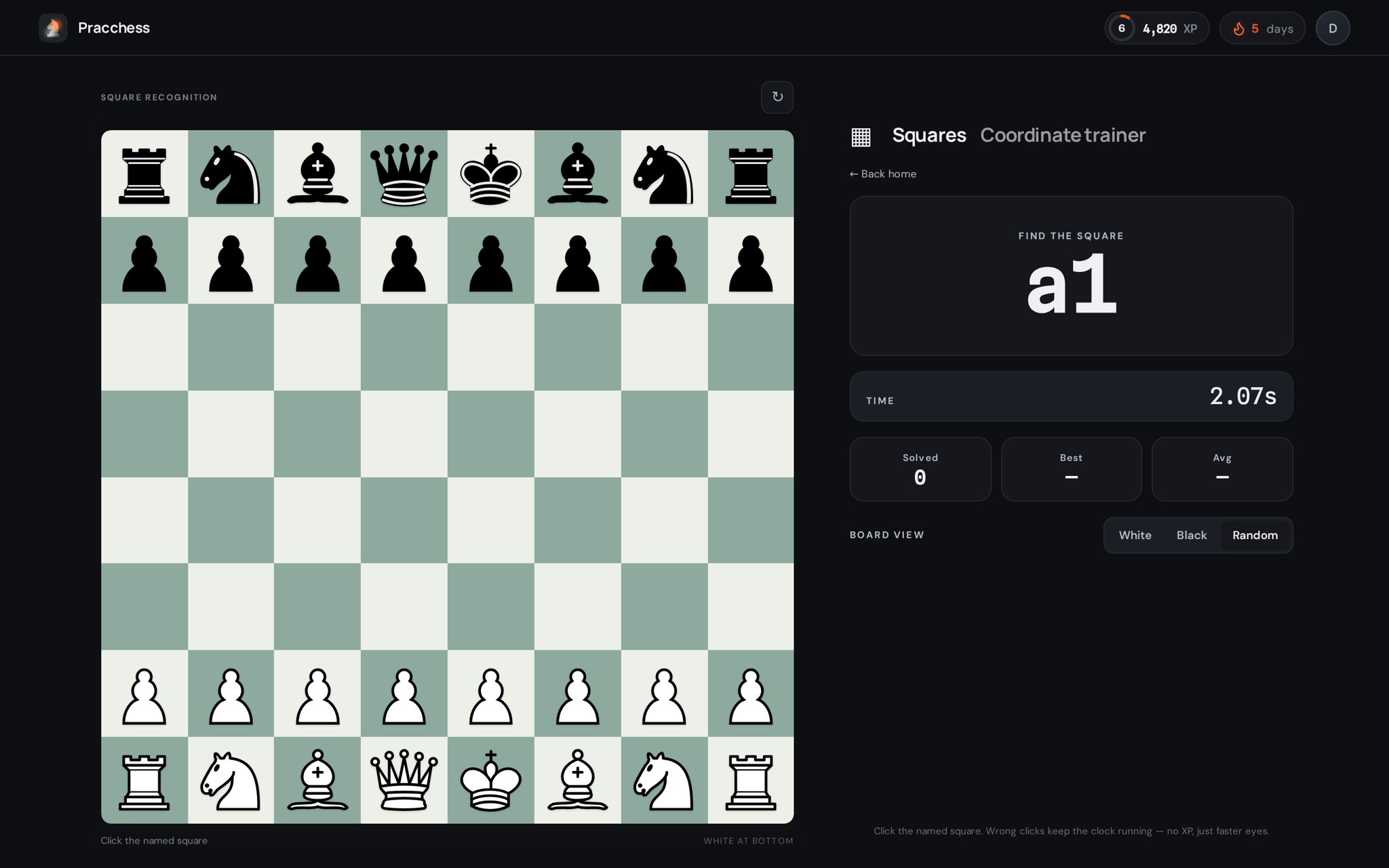
The squares trainer names a coordinate and starts the timer. Find it, and the next one appears. There is no XP and no ending. Just a best time, an average, and a board that can face either colour or flip at random.
It sits beside the repertoire and the puzzles because board vision is the thing that makes the rest of it usable under pressure.
Everywhere
The same trainer, in your pocket.
The iOS app is built with Expo Router, TypeScript, and EAS Build. It shares the same lessons, the same Firebase backend, and the same idea of what practice should feel like.
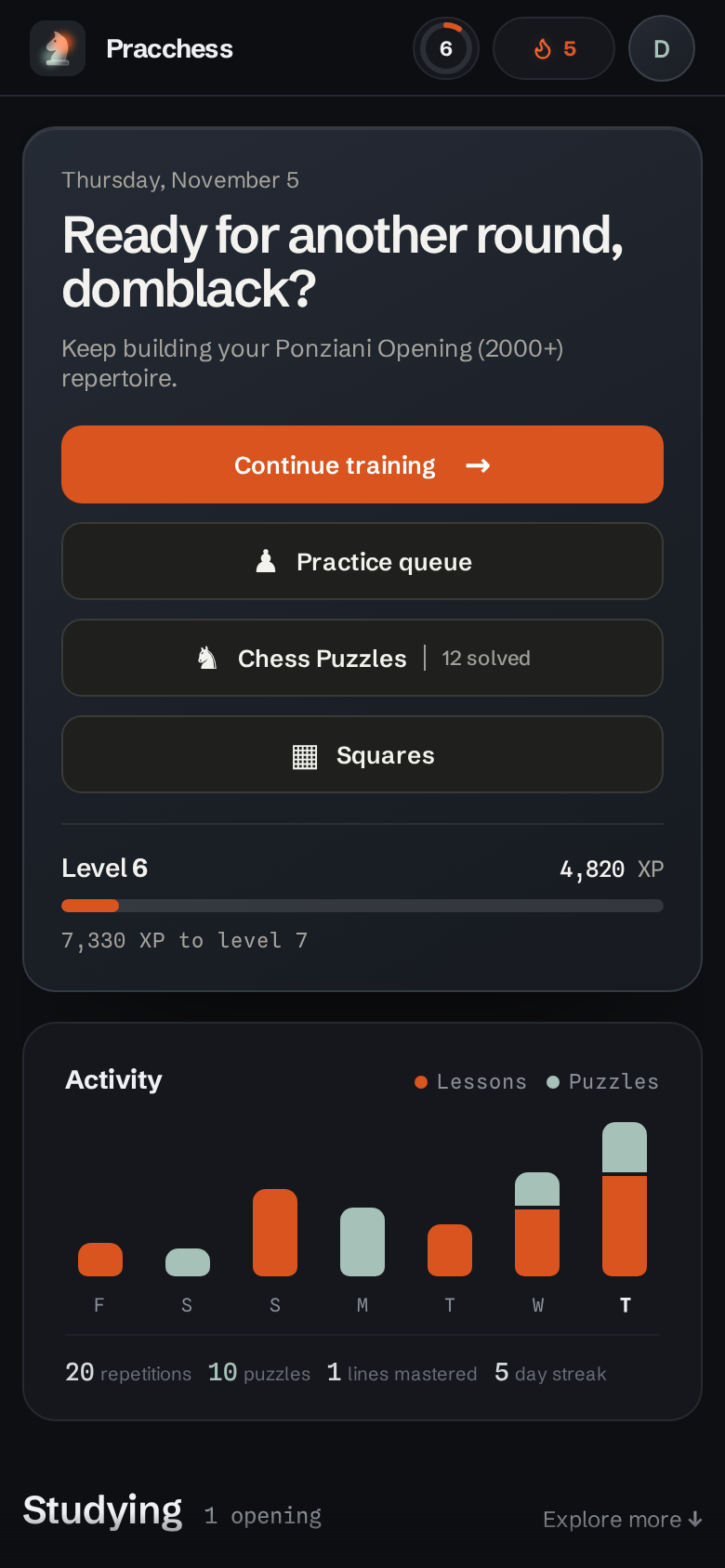
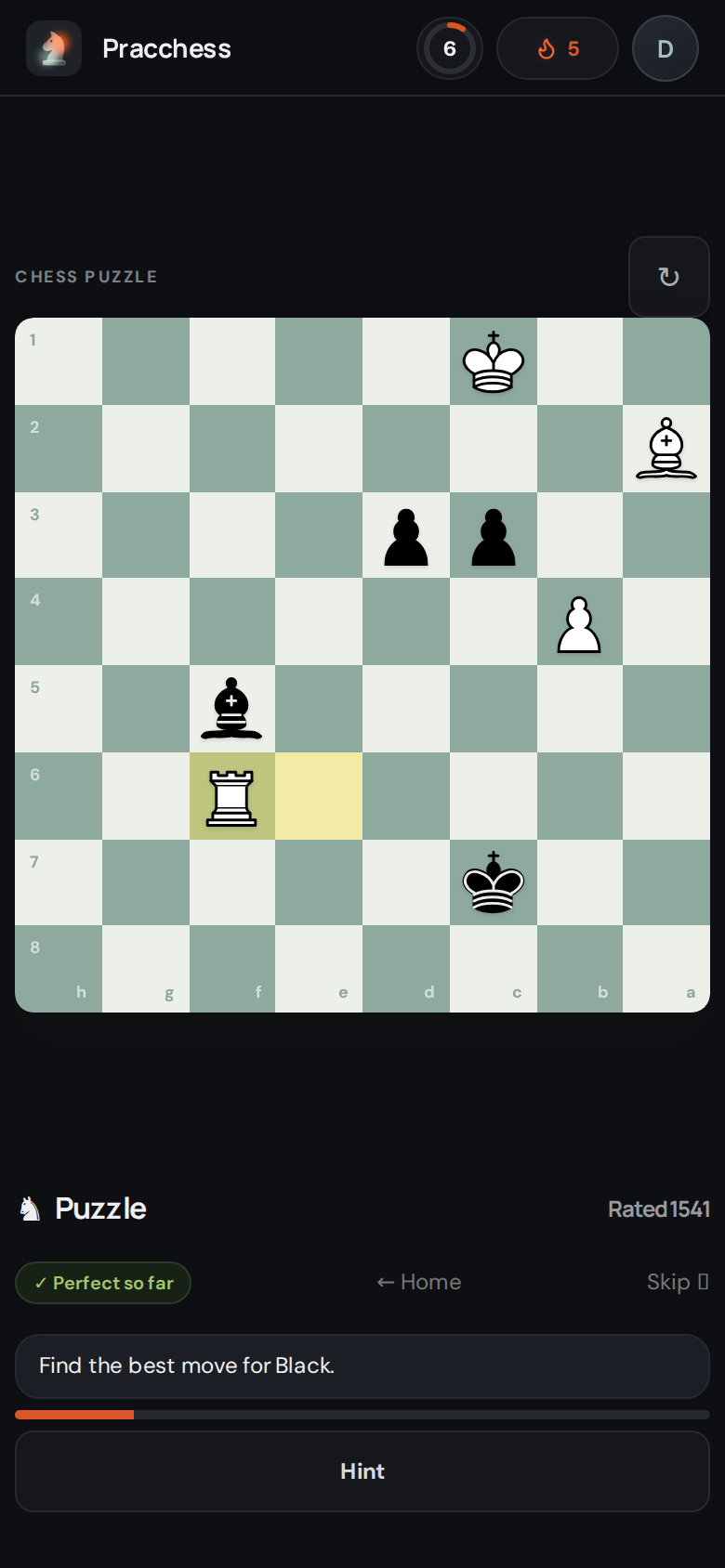
No framework. No bundler. No runtime dependencies.
The web client is plain ES modules, a stylesheet, and a static server. Firebase handles identity and data. Cloud Functions enforce the rules. It still feels like an app.
Your move
Start your opening prep.
Pick a repertoire, play the first line, and let the repetitions do the rest. Free to use in the browser.